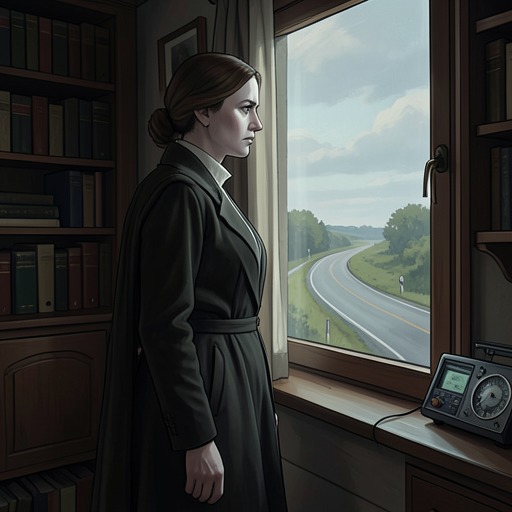
Elsa Mackenbourg
Bonjour tristesseElsa Mackenbourg is Raymond’s mistress during the summer at the villa, where her uncomplicated companionship initially belongs to the carefree household he shares with Cécile. Her role changes when Raymond’s relationship with Anne Larsen moves toward marriage: Elsa’s feelings make her vulnerable to Cécile’s appeals, and her apparent return to Raymond becomes part of the daughter’s effort to disrupt the engagement. Yet Elsa is not only a device in that scheme. Her tears, lingering attachment, and romantic investment in small signs of attention show a person whose expectations exceed the casual world in which she has been placed.
Identity and Place in the Household
At the beginning of the summer, Elsa is Raymond’s current mistress. He is forty, widowed for fifteen years, and accustomed to changing partners about every six months; Cécile has gradually accepted this pattern as part of her father’s lively, shifting way of life. She loves him and knows his need for women, so she does not object to Elsa joining them for the holiday. In Cécile’s account, Elsa is a tall, red-haired woman who works as an extra in studios and in bars on the Champs-Elysées. She is kind, fairly simple, and without serious pretensions—a description that marks her, in Cécile’s eyes, as an easy companion rather than a threat to their established intimacy.
The villa and its beach place Elsa inside a holiday routine shaped by leisure: the household has rented the white villa for two months, and the first days pass in sun and swimming. The contrast between Elsa’s body and the others’ holiday tans is concrete and comic. While Cécile and Raymond gradually acquire a healthy golden color, Elsa turns red and peels in painful patches. The detail situates her within the group’s shared pleasures while also giving her a vulnerability that resists the polished image of effortless seaside enjoyment.
Relationship with Raymond and Cécile
Elsa’s connection to Raymond belongs to a wider pattern of temporary affairs, but Cécile understands that impermanence need not mean an absence of tenderness. Raymond rejects fidelity and binding commitments as arbitrary, yet Cécile sees him as capable of devotion precisely because he regards it as provisional. That understanding helps explain why Elsa can be part of the household without appearing, at first, to unsettle its affectionate equilibrium. The arrangement suits Cécile’s inherited assumptions about love: intense, enjoyable, and passing rather than governed by permanence.
Elsa’s place becomes more precarious with Anne’s arrival. When Cécile explains that Raymond went to the station with Elsa to meet Anne, Anne’s composed expression breaks; she repeats Elsa’s full name in disbelief. The moment exposes how differently the same arrangement is seen from within and outside Raymond and Cécile’s familiar world. What Cécile treats as ordinary, Anne experiences as a startling breach of expectation.
Cécile later remembers Elsa’s grief when the two of them are caught in the consequences of a changing romantic arrangement. Elsa cries softly and recalls how happy they had been; a South American man beside her also weeps and repeats the same thought. Cécile is moved by the scene and wants to spare Elsa further pain. The tears complicate the earlier portrait of a woman who can be casually included and excluded: Elsa experiences the loss as real, even when the people around her have treated love as temporary.
The Engagement and Cécile’s Scheme
After spending time away from the villa, Elsa returns for her suitcases. She says that Juan has bought her a few dresses, but not enough. Cécile is pleased to see her because Elsa brings back the atmosphere of bars and easy evenings associated with happier days. Elsa says that she and Cécile have always got along and have things in common. When Cécile mentions Raymond, Elsa makes a small movement of her head; Cécile now notices it as a possible sign that Elsa still loves him, something she believes she would have overlooked only three weeks earlier.
Elsa asks whether Raymond is happy. Cécile senses that the question gives her an opening. She answers that happiness is too strong a word and portrays Anne as adept at controlling him. Then she tells Elsa that Anne has decided to marry Raymond. Elsa responds with shock that Raymond wants marriage at all. Cécile’s account of the engagement is designed to stir Elsa’s feelings, but it also expresses Cécile’s own resistance: she presents marriage as the end of the life the three of them have known and casts Raymond as a child who must be protected. Her plea asks Elsa to act for Raymond, for herself, and for their love.
Elsa’s response makes her an emotional participant in Cécile’s plan, though the evidence does not establish that she knows the full design. She is horrified by the prospect of Raymond marrying, and Cécile sees her face register the blow. The relationship thus becomes a triangle of competing understandings: Cécile treats Elsa’s attachment as leverage, Elsa reacts as a woman whose place beside Raymond may be disappearing, and Raymond’s choices remain the object around which both women’s hopes turn.
Elsa’s Performance and Remaining Attachment
Cécile also invokes Charles Webb, who had been Elsa’s lover for a long time. Webb works in theatrical publicity, while his wife spends rapidly the money he earns; Cécile describes him as perpetually hurried and anxious about making ends meet. Elsa, despite her beauty, had not been especially greedy about money, and that quality had appealed to him. Cécile reports Elsa’s belief that Webb adores her and that seeing her again might prompt him to push Raymond back toward her. The account links Elsa’s past relationship to her present predicament without making either attachment a simple matter of calculation.
During the later days, Elsa arranges to be repeatedly where Raymond is and interprets his looks and movements as evidence of victories and suppressed feelings. Cécile regards these triumphs as imaginary, yet notices how seriously Elsa invests in them. Someone accustomed, in Cécile’s judgment, to the hurried attentions of men has become excited by glances and gestures and absorbed in a subtle romantic role. Elsa’s performance may be part of the effort to draw Raymond back, but it also reveals how readily she gives small signs an emotional meaning. Cécile’s own strategy depends on that susceptibility even as she watches it with a mixture of observation and unease.
Aftermath and Narrative Significance
At a later meeting on the beach, Elsa tells Cécile that she has just seen Raymond. She reports that he regretted what had happened and said he had behaved like a cad. The exchange returns attention to Raymond’s conduct and Elsa’s willingness to receive his apology; it does not, by itself, settle the future of their relationship. Elsa remains connected to the old, shifting arrangement even as the plot moves toward consequences beyond the reach of the earlier romantic maneuvering.
After Anne’s fatal accident, Elsa waits with Cyril on the steps of the house. Cécile sees them as pale, almost forgotten figures, neither of whom knew or loved Anne. Their presence stands apart from the grief inside: Elsa and Cyril belong to the summer’s smaller love stories, while Cécile and Raymond confront the loss of the woman whose place in their lives had been contested. Elsa’s ending is therefore not a final resolution of her relationship with Raymond, but a diminished narrative position. She remains visible at the threshold of the household, while the emotional center has shifted to the bereaved father and daughter.